Moody's 2027 Outlook: Why Higher Rates and Energy Costs May Offset the AI Tailwind
Key takeaways
- Weakening credit: Global credit conditions are expected to weaken by 2027 due to high borrowing costs and energy prices (newsable.asianetnews.com).
- Refinancing gap: New high-yield bond issues are currently pricing approximately 100 basis points higher than the debt they are replacing (moodys.com).
- AI tailwind: US hyperscaler capital expenditure is on track to approach $1 trillion in 2027 (moodys.com).
- Banking stability: Global banks are expected to maintain stable credit profiles in 2027 due to strong capitalization and resilient deposit franchises (aninews.in).
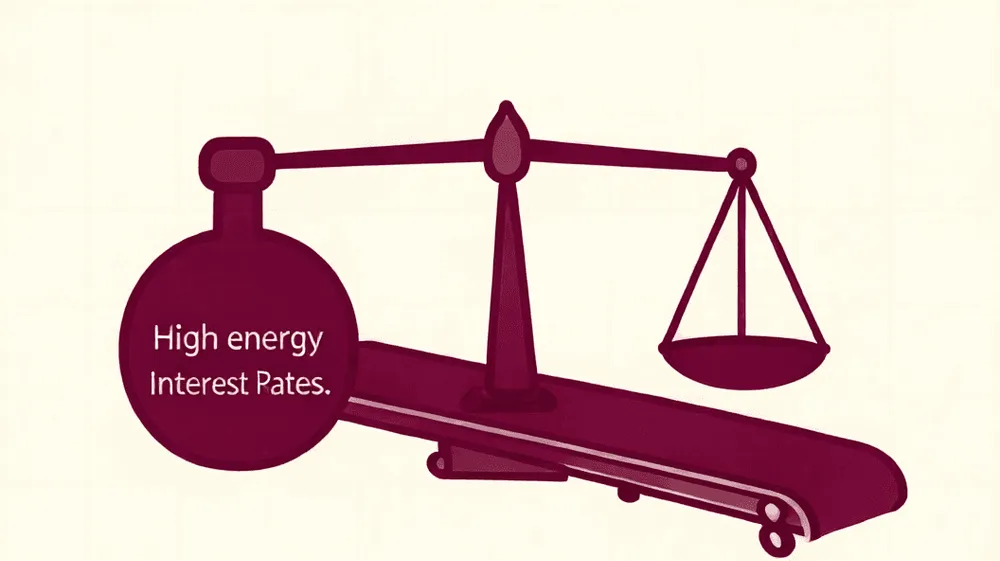
Moody's Ratings projects that global credit conditions will weaken by 2027 due to high borrowing costs and energy prices (newsable.asianetnews.com). This shift suggests that the macro environment is moving from a period of monetary easing toward a regime defined by persistent structural costs. While the massive capital requirements of the artificial intelligence build-out provide a significant tailwind for certain sectors, the broader credit market faces a tightening of terms and a rise in default probabilities for highly leveraged entities (moodys.com).
The refinancing cliff: The 100 basis point reality
A primary mechanism driving the projected weakening in credit is the delayed impact of higher borrowing costs (aninews.in). Many corporate borrowers are currently entering a refinancing cycle for debt issued during the previous low-interest-rate period. This transition is not a lateral move. New high-yield bonds are currently being issued at rates approximately 100 basis points higher than the debt they are replacing (moodys.com).
From a credit view, this 100 basis point spread increase represents a direct hit to interest coverage ratios. When a borrower replaces old debt with new debt at a significantly higher coupon, the cash flow available for debt service (CFADS) decreases, even if the EBITDA remains constant. A credit committee looking at a refinancing proposal in this environment would focus on the "interest coverage gap." If the new interest expense consumes a larger portion of operating income, the margin for error in the borrower's business model shrinks significantly.
The practical implication is a bifurcation in the credit market. Companies with high interest coverage can absorb the 100 basis point increase. Companies operating near their covenant limits may find themselves in technical default or forced to seek equity injections to maintain their leverage profiles. The risk is concentrated among those who relied on cheap liquidity to fund growth that has not yet reached full maturity.
The 100 basis point premium on new high-yield debt is not just a cost of capital issue; it is a fundamental stress test for the cash flow of highly leveraged borrowers (moodys.com).
Why It Matters
AI capital expenditure: A concentrated tailwind
The most significant growth driver in the current cycle is the massive investment in digital infrastructure. US hyperscaler capital expenditure is on track to approach $1 trillion in 2027 (moodys.com). This level of spending creates a massive "pull" effect on credit markets, but the benefits are not distributed evenly. Credit risk is concentrated among lenders, leveraged developers, and structured finance vehicles that fund the AI build-out (moodys.com).
A lender evaluating a project in the AI infrastructure space would apply a different set of gates than they would for a traditional industrial borrower. The credit view here focuses on the "asset-to-revenue" link. Because the capital expenditure is so high, the collateral (often specialized data center hardware or land) must be matched against the certainty of long-term, inflation-indexed contracts from hyperscalers. The risk is that the build-out outpaces the ability of the underlying entities to generate the cash flow required to service the debt used to build them.
Analysis of this sector requires comparing two scenarios:
- Scenario A (The Infrastructure Play): Developers with long-term, creditworthy tenants (hyperscalers) show stable cash flows and high collateral value. The credit profile remains strong despite high debt levels.
- Scenario B (The Speculative Build): Developers relying on short-term financing or speculative tenants to fund rapid expansion. These entities face extreme sensitivity to interest rate volatility and energy price spikes (newsable.asianetnews.com).
Energy costs and the margin squeeze
While AI drives demand, energy costs act as a persistent drag on credit quality. Moody's notes that high energy prices are a key driver for the weakening of global credit conditions heading into 2027 (newsable.asianetnews.com). For energy-intensive industries, this represents a direct increase in operating expenses (OPEX) that cannot always be passed through to the consumer, particularly in a market where GDP growth is projected to be approximately 1.7 per cent across G20 advanced economies (aninews.in).
When energy costs rise alongside interest rates, the "double squeeze" on margins becomes acute. A credit committee would look at the "EBITDA-to-Energy-Input" sensitivity. If a 10% increase in energy prices leads to a 5% drop in EBITDA, the borrower's ability to service debt becomes highly volatile. This is especially true for manufacturers and heavy industrial firms that lack the pricing power to offset rising input costs.
The counter-reading to this concern is the potential for energy-efficient technologies to decouple growth from energy consumption. However, for the 2027 outlook, the immediate reality is that energy volatility remains a primary credit risk factor (newsable.asianetnews.com).
Banking stability vs. non-bank risk
There is a notable divergence in the credit profiles of different financial institutions. Moody's Ratings expects global banks to maintain stable credit profiles in 2027 due to strong capitalization, resilient deposit franchises, and sustained profitability (aninews.in). Banks are positioned to benefit from higher interest rates, which can improve net interest margins (NIM) (moodys.com).
However, the risk is shifting toward the "shadow banking" sector. Moody's notes that expanding private-market exposures and the interconnectedness between banks and non-bank financial institutions (NBFIs) could create difficult-to-assess risks during financial stress (aninews.in). As banks move certain risks off their balance sheets to private credit funds, the transparency of the total credit ecosystem decreases. If a systemic shock occurs, the interconnectedness between these NBFIs and traditional banks could lead to rapid contagion.
| Sector/Entity | 2027 Credit Outlook | Primary Driver/Risk |
|---|---|---|
| Global Banks | Stable (aninews.in) | Strong capitalization and resilient deposits (aninews.in) |
| AI Infrastructure Developers | Concentrated Risk (moodys.com) | High CAPEX requirements and energy sensitivity (newsable.asianetnews.com) |
| G20 Advanced Economies | Moderate Growth (aninews.in) | GDP growth projected at 1.7 per cent (aninews.in) |
Illustrative example
The following numbers are hypothetical and round. Consider a mid-sized industrial manufacturer that needs to refinance $500 million in maturing debt in 2027. Under the old regime, the debt carried a coupon of 4% ($20 million annual interest). If the company's EBITDA is $100 million, its interest coverage ratio drops from 5.0x to 4.0x. While 4.0x is still healthy, a further 20% decline in EBITDA due to rising energy costs would drop the coverage to 3.3x, significantly reducing the lender's margin of safety and potentially triggering a covenant breach if the debt-to-EBITDA ratio is also tied to interest-adjusted metrics.
The Credit View: A Five-Point Assessment
When evaluating exposure to these shifting conditions, credit professionals should apply the following five-point framework to any new or renewing credit facility:
- Cash Flow: Can the borrower withstand a 100 basis point increase in interest expense and a simultaneous 10% increase in energy costs? (moodys.com) (newsable.asianetnews.com)
- Collateral: For AI-related infrastructure, is the collateral specialized hardware that holds value, or is it highly depreciable equipment with limited secondary markets? (moodys.com)
- Covenants: Are there "maintenance covenants" that protect against the margin squeeze, or are they "incurrence-based" which only trigger during a default event?
- Structure: Is the debt senior to the capital expenditures being made, or is the borrower using new debt to fund the CAPEX required for the next growth phase? (moodys.com)
- Sponsor/Management: Does the management team have a proven track record of navigating high-interest-rate environments, or was their success predicated on cheap liquidity?
The divergence between stable bank profiles and weakening corporate credit suggests that the risk is moving from the balance sheets of lenders to the balance sheets of borrowers (aninews.in).
Watch For
Strategic Next Steps
For CFOs and Treasurers, the priority must be liquidity management and proactive refinancing. Waiting for the "perfect" moment to refinance may result in being caught in a high-rate window when liquidity in the bond market tightens due to geopolitical fragmentation or trade wars (aninews.in).
For Lenders and Credit Officers, the focus must shift to monitoring the "non-bank" nexus. As credit risk becomes more concentrated in structured finance vehicles and private credit, the ability to assess the true level of leverage in the system becomes more difficult (moodys.com) (aninews.in).
Watch for these indicators through 2027:
- The actual spread between new high-yield issuances and existing debt benchmarks (moodys.com).
- The stability of deposit franchises in the banking sector as interest rate regimes persist (aninews.in).